
Salamu
Lesson 1: Basic Greetings/Everyday Greetings
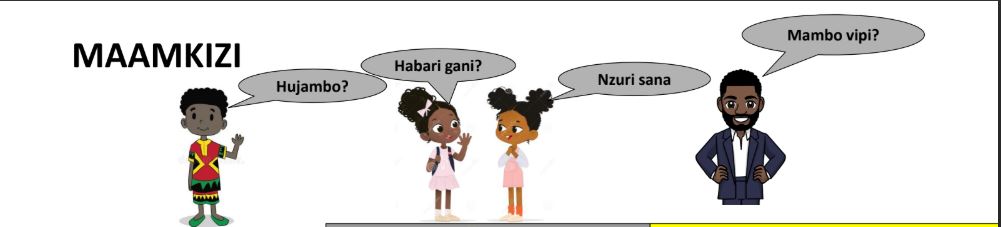
Why Greetings Matter in East Africa in Western cultures
A greeting is often a quick, transactional transaction (e.g., “Hi, how are you?” answered by a brief “Good”). In East African culture, greetings are a vital social ritual. Skipping or rushing a greeting is considered highly impolite. A proper greeting establishes mutual respect, shows a person’s well-being, and opens the door for meaningful interaction.Mastering greetings automatically helps you connect with the locals the when you arrive .
The most common way of saying hello is Habari . It also translates to “news” and is used across all age groups.
- Habari?
meaning:How are things?/ Any news
- Habari gani ?
meaning:What’s the news ?/ Any news
- Habari za asubuhi?
meaning:Good morning?/News of the morning?
- Habari za mchana ?
meaning:Good afternoon/News of the afternoon?
- Habari za jioni?
meaning:Good evening?/ News of the evening?
How to respond to these greetings:
Swahili greetings focuses on positivity thus responses are always optimistic .
- Nzuri – Good / Fine
- Nzuri sana – Very good
- Salama -Peaceful / Safe
Apart from Habari , Jambo is also listed as a word used for hello .
- Hujambo – Hello (Used when speaking to one person)
Meaning: Do you have any issues/problems
Response : Sijambo Meaning : I have no issues / I am fine
- Hamjambo – Hello guys (Used when speaking to two or more people)
Meaning: Do you any issues/problems
Response : Hatujambo Meaning : We have no issues / I am fine
Section 2: Greetings for Different Times of Day
Swahili speakers often greet each other according to the time of day.
Habari ya asubuhi – Good morning
Habari ya mchana – Good afternoon
Habari ya jioni – Good evening
Siku njema – Have a good day
Shinda salama – Stay safe during the day
Safiri salama – Travel safely
Section 3: Respectful Greetings and Cultural Etiquette
Respect is highly valued in Swahili culture.
Shikamoo
Meaning: My respects to you.
Used by a younger person when greeting an elder, teacher, leader, or respected person.
Marahaba
Meaning: I accept your respect.
Used as the response to Shikamoo.
Section 4: Street Swahili and Youth Culture
- Mambo ?
Response: Poa – Cool /Great
Meaning: How are things/what’s up ?/How is it
- vipi ?
Response: Safi – Cool /Great
Meaning: How are things/what’s up ?/How is it ?
Cultural Tip
When greeting an elder, it is common to shake their right hand while supporting your right elbow with your left hand. This gesture shows respect and humility.
Practice Excercise
Test your understanding by choosing the correct answer for each question.
1. Which greeting would you use in the morning?
A. Habari ya jioni
B. Habari ya mchana
C. Habari ya asubuhi
D. Mambo
2. How do you respond to Hujambo?
A. Hatujambo
B. Marahaba
C. Sijambo
D. Salama
3. Which greeting is used when speaking to two or more people?
A. Hujambo
B. Habari
C. Hamjambo
D. Mambo
4. Which greeting shows respect to an elder, teacher, or leader?
A. Mambo
B. Habari
C. Vipi
D. Shikamoo
5. What is the correct response to Shikamoo?
A. Poa
B. Nzuri
C. Marahaba
D. Salama
6. A friend greets you by saying Mambo? What is the best response?
A. Marahaba
B. Poa
C. Sijambo
D. Hatujambo
7. Which phrase means Travel safely?
A. Shinda salama
B. Habari ya jioni
C. Safiri salama
D. Salama
8. Which greeting can be used with people of all ages?
A. Shikamoo
B. Habari
C. Hamjambo
D. Mambo
9. True or False
“Yeye” is the response to “Shikamoo.”
True
False
10. True or False
In East African culture, greeting someone is an important sign of respect.
True
False
Challenge
You arrive in Kenya at 8:00 a.m. and meet your hotel receptionist. Which greeting would you most likely use?
A. Habari ya jioni
B. Habari ya asubuhi
C. Hamjambo
D. Vipi